
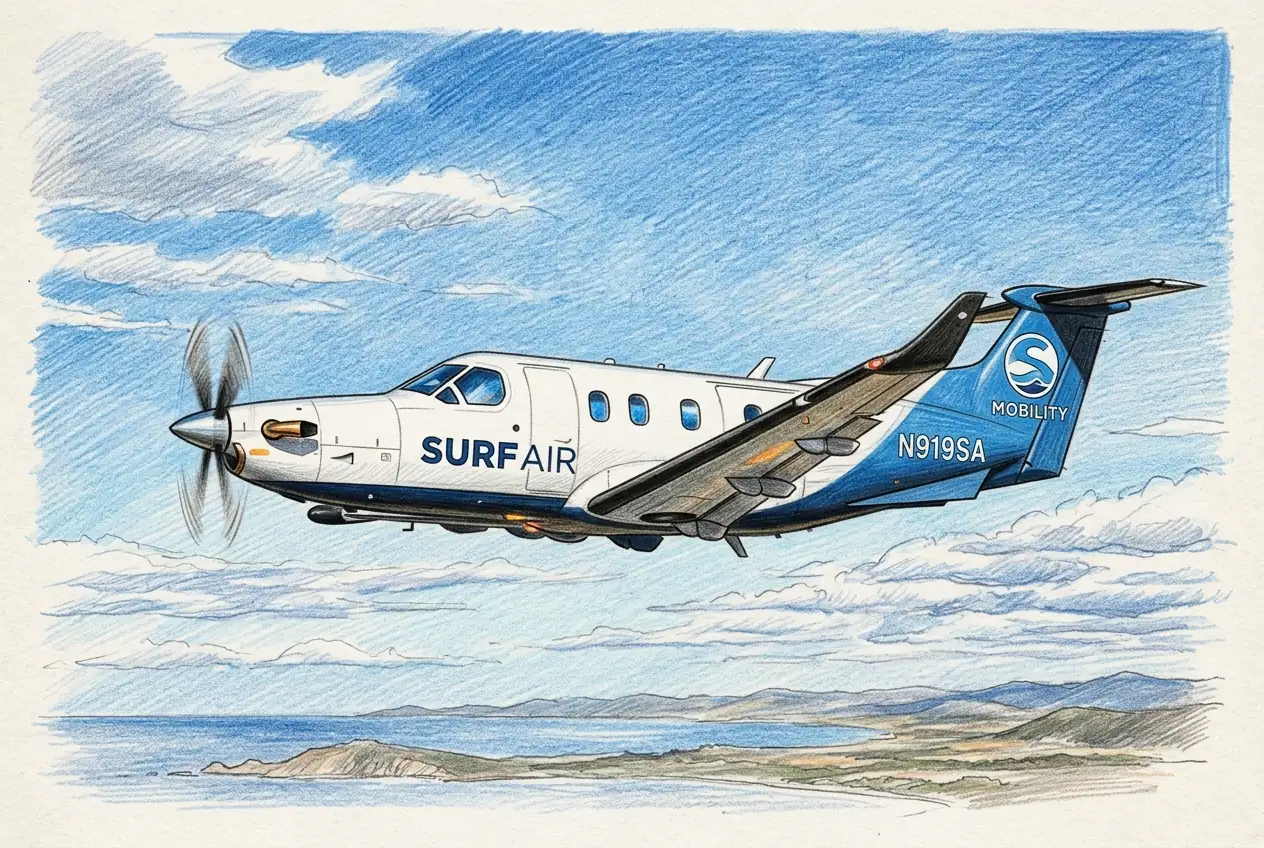
Shares of Surf Air Mobility shifted higher in pre-market trading, touching $0.98 — a 5.4% gain — after the company announced its fifth commercial agreement for its airline operations software platform, this time with charter operator Flying Zebra. The deal puts Surf Air on track to meet its stated goal of five operators live on its software by year-end, but investors are right to ask whether milestones for a company trading under a dollar translate into meaningful economics. Surf Air Hits Five Software Deals — But Can a Cash-Strapped Airline Turn a Tiny Platform Into a Lifeline?
Shares shifted as Surf Air Mobility climbed 5.4% to $0.98 following its announcement of a fifth deal to sell its flight-operations software to outside charter operators. The agreement with Flying Zebra — a company that currently operates four aircraft — is modest in scale, but it represents a strategic pivot that investors in this deeply distressed sub-dollar stock are betting could eventually change the company's economics.
Five Contracts Signed, but the Customer Base Is Tiny
The Flying Zebra deal is Surf Air's fifth commercial contract for its AI-powered aviation platform, developed with Palantir Technologies, bringing the company closer to its goal of five operators actively using the software by year-end. That sounds like progress — until you consider that the FAA lists around 1,800 certificated charter operators with more than 11,000 aircraft, and many have only a couple of aircraft. Five contracts covering small operators barely scratches the surface of a fragmented industry.
Revenue-Sharing Sounds Good, but the Math Is Microscopic
Surf Air will receive a percentage of revenue from every Flying Zebra trip managed through the software, though financial terms were not disclosed. With a four-plane fleet, even a generous revenue share will contribute negligibly to a company guiding full-year 2026 revenue of $128 million to $138 million. The real question is whether Surf Air can sign dozens more operators and turn small per-trip fees into a meaningful recurring software income stream.
The Balance Sheet Casts a Long Shadow This news lands against a grim financial backdrop. Surf Air reported a Q2 2026 net loss of $28.1 million and held $18.5 million in cash, with negative equity of $42.5 million.
Management has disclosed "substantial doubt" about its ability to continue as a going concern, with $11.1 million in defaulted federal excise taxes. Software deals generate headlines, but they don't solve a liquidity crisis.
Palantir Partnership Adds Credibility, Not Cash
The software has been used internally to run Surf Air's own airline operations since 2025, and the FAA recently approved it as an authorized electronic recordkeeping system — real validation. But credibility from a Palantir co-development relationship doesn't replenish a cash balance that was $4.2 million as recently as Q1. Investors cheering today's pop should weigh whether five small-operator contracts can outrun the company's cash burn of roughly $13 million every six months on operations alone.